


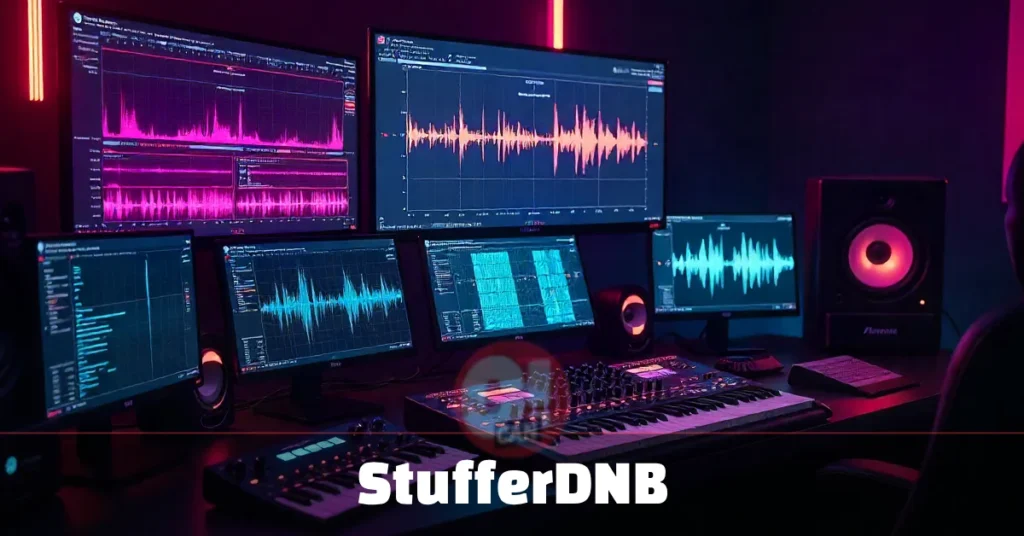
StufferDNB is an emerging drum and bass subgenre defined by dense sound layering, atmospheric depth, and intricate percussion detail. Unlike traditional DnB, it prioritises textural richness and emotional complexity over direct energy, typically operating at 170–178 BPM while blending ambient, techno, and industrial elements into cohesive, immersive tracks.
What Makes StufferDNB Different From Regular Drum and Bass
When most people think of drum and bass, they picture fast breakbeats and aggressive drops that shake a dance floor. StufferDNB flips this expectation. Instead of stripping sounds down to their essentials, producers deliberately pack tracks with overlapping layers—hence the name “stuffer”—to create what listeners describe as immersive sound worlds.
The core difference lies in production philosophy. Standard drum and bass chases impact through clarity and punch. StufferDNB chases presence through density. A kick drum in regular DnB might be a single, clean sound. In StufferDNB, that kick often contains 2–4 separate layers: a sub-bass for low-end impact, a punchy mid-range click, a crisp top-end snap, and sometimes a filtered or distorted tone underneath for texture. Every element gets its own processing chain, reverb tail, and spatial position.
This approach alters the way the music feels. StufferDNB listeners describe experiences like “floating through a detailed environment” rather than “getting hit with energy.” The tracks maintain drum and bass’s foundational speed (170–178 BPM) but replace the directness with subtlety. You’ll notice ghost notes floating between main drum hits, barely-there pads swelling in the background, and bass movements that shift rather than explode.
The emotional signature matters too. Traditional DnB often aims for tension and release. StufferDNB aims for atmosphere with momentum—a sense of motion without necessarily building toward a climactic drop. Some tracks never have a “drop” at all, instead revealing new textures every 8 or 16 bars until you’re hearing something completely different from where you started.
The Production Techniques Behind StufferDNB’s Depth
Creating that packed, detailed sound requires specific production strategies that separate StufferDNB tracks from adjacent styles. Understanding these techniques explains why the music feels so complete compared to lighter drum and bass productions.
Drum Layering Architecture. The drum skeleton of StufferDNB typically starts with a standard four-on-the-floor kick pattern, but then producers add what’s called “ghost note density.” These are secondary hits—usually at lower volumes—that sit between main beats. A hi-hat pattern might contain 6–8 separate samples layered together rather than a single loop, creating a texture that feels almost orchestral. Snares often involve 4–6 distinct layers: a tight snap, a deeper body sound, a noise tail, and sometimes reversed or side-chained elements for animation.
Bass Synthesis and Layering. This is where StufferDNB truly separates itself. Rather than designing one bass sound, producers create three to five complementary bass sources. A typical stack includes a sub-bass providing warmth, a mid-bass adding movement through modulation, a distorted or saturated tone adding grit, and often a fifth layer using granular processing for textural depth. Each layer runs through its own effects chain—some with reverb, others with delay, others with subtle distortion. The key is that these layers never collapse into a single, obvious bass sound; instead, they create a unified bass sensation with internal complexity.
Granular and Textural Elements. Producers use specialised tools like Portal (by Native Instruments), Quanta, or Ableton’s Granulator to manipulate sounds into unrecognisable textures. They might take a vocal sample, stretch it, grain it into abstract clouds, and place it subtly underneath a drop. Field recordings—rain, traffic, crowd noise—appear as barely-conscious ambient layers. Reversed reverb swells, stretched pad transitions, and layered noise elements fill every available frequency space without creating a muddy mix.
Off-Grid Timing and Humanisation. StufferDNB drum patterns often use what’s called “micro-timing”—pushing or pulling individual notes fractions of a millisecond off the quantised grid. This creates the sensation of live drumming even in fully programmed tracks. A hi-hat might sit 3 milliseconds early, the next one 2 milliseconds late, and so on. Combined with slight velocity variations, this makes the percussion feel “alive” and present rather than mechanical.
How StufferDNB Fits Into the Broader DnB Ecosystem
StufferDNB doesn’t exist in isolation; it sits within drum and bass’s larger taxonomy. Understanding where it belongs helps producers and listeners find related music and predict where the genre might evolve.
Traditional drum and bass subgenres prioritised specific production qualities: liquid DnB emphasised melodic smoothness, neurofunk focused on dark synth stabs and tight programming, jump-up chased straightforward energy. StufferDNB emerged as a deliberate reaction to minimalism trends within DnB, pulling influence from adjacent genres that were already embracing complexity.
The style borrows from ambient electronics—specifically its use of space, reverb, and the idea that a track could be “about” atmosphere rather than structure. It borrows from industrial and darkwave music the use of metallic, textured sounds as primary elements. Halftime breakbeats (slowed down to roughly 85 BPM for artistic effect within 170+ BPM context) appear frequently. Granular synthesis techniques come directly from contemporary classical and experimental electronic music.
What makes StufferDNB distinct isn’t any single element but the specific combination. Liquid DnB can have pads and smoothness, but lacks the intricate micro-percussion. Experimental electronic music can layer textures, but lacks the rhythmic foundation and energy. StufferDNB holds both simultaneously, creating a space that didn’t clearly exist before.
This positioning means StufferDNB appeals to listeners who might not typically engage with drum and bass. People who enjoy ambient, downtempo, or experimental electronic music find entry points through StufferDNB’s atmospheric layers. Meanwhile, DnB enthusiasts who want to explore beyond straightforward energy consumption find creative depth and technical challenge.
The Production Tools and Workflow for StufferDNB
Producers creating StufferDNB typically work within specific DAW environments and plugin ecosystems that make density and complex sound design possible.
DAW Selection. Ableton Live dominates StufferDNB production primarily because its rack architecture—the ability to chain and arrange effects and instruments—makes layering intuitive. FL Studio’s pattern system handles the syncopated, off-grid drum work efficiently. Logic Pro appeals to producers who want to mix traditional sample-based work with synthesis. Cubase and Bitwig each bring specific advantages for mixing multiple layers and automation. The choice matters less than the workflow flexibility these platforms offer.
Essential Plugins for Layering and Movement. Wavetable synthesis tools like Serum, Massive X, and Vital handle bass sound design. Native Instruments Phase Plant excels at modulation and creating movement within single oscillators. For granular work, Portal and Quanta are industry standards—they take audio input and transform it into abstract, textured clouds. Saturation and warmth come from tools like Decapitator or Saturn 2, which add harmonic complexity without obvious distortion. Reverb choices matter significantly; producers often use multiple reverb instances with different settings rather than one room simulation. Compression typically involves parallel chains rather than straightforward dynamics control, meaning part of the signal stays uncompressed while another part gets heavily compressed, then these are blended.
The Resampling Workflow. Most StufferDNB producers use a technique called resampling, where they export sections of their own work and reimport them as audio material. They might export a bass design, chop it up, apply granular processing, and integrate it as a texture layer. This workflow creates new material from existing work and ensures organic cohesion rather than disconnected layer combinations.
Mixing Considerations. StufferDNB mixes require more headroom than typical DnB tracks because so many elements compete for space. Producers often keep the master volume lower during creation, mix individual elements more quietly, and rely on sidechain compression creatively—using the kick to pump other elements, creating rhythmic breathing throughout the track. Stereo width management prevents the mix from feeling too wide and losing impact; careful automation of panning and reverb space keeps everything anchored while still creating that spacious feeling.
Where You’ll Actually Hear StufferDNB Today
StufferDNB exists primarily in three spaces: online communities, certain record labels, and progressive DJ sets at electronic music venues.
The Online Community. Reddit’s drum and bass communities, specialised Discord servers focused on sound design, and dedicated YouTube channels serve as primary spaces where StufferDNB producers and listeners congregate. These aren’t mainstream venues with millions of users, but rather focused communities of 2,000–50,000 people who actively share production techniques, unreleased tracks, and discussion about stylistic evolution. SoundCloud still functions as a distribution hub where producers release tracks before seeking label interest. Bandcamp has become popular for StufferDNB artists to sell music directly and connect with listeners.
Label Representation. While StufferDNB hasn’t dominated major labels, certain independent releases on respected imprints have featured elements of the style. Metalheadz, known for experimental DnB, occasionally features heavily textured work. Hospitals Records’ deeper releases share StufferDNB’s emotional sophistication. Smaller, artist-run labels focused on experimental electronic music increasingly lean into full StufferDNB releases. This represents a conscious positioning—these labels see StufferDNB as the future of sophisticated drum and bass production.
Club and Festival Context. Progressive DJ sets increasingly feature StufferDNB alongside other textured, atmospheric styles. Rather than appearing at high-energy dance events, StufferDNB fits better in venues treating electronic music as an art form, with visual installations and a focus on the listening experience. Some producers have begun creating live shows where StufferDNB production combines with modular synthesisers and visual projection, creating the cinematic experience the music already suggests.
Learning and Creating StufferDNB Yourself
For producers interested in creating StufferDNB, the learning curve involves understanding both drum and bass fundamentals and textural sound design—a combination that takes time but remains approachable.
Start With Drum Sequencing. Before layering complexity, understand how to program the core drum pattern. Learn to use swing and micro-timing rather than quantising everything rigidly to the grid. Develop comfort with syncopation—the conversation between kick, snare, and hi-hat that makes the rhythm feel intentional rather than mechanical. Spend time listening to StufferDNB tracks and analysing what drums do between the main beats.
Study Bass Design Specifically. Rather than immediately attempting five-layer bass sounds, build competence with single-note bass design using a synth. Learn wavetable basics, understand how to create movement through filter automation and LFO modulation, then begin stacking complementary sounds. Export your bass designs, experiment with what happens when you layer them, and gradually build the intuition for how complementary bass layers enhance rather than muddy each other.
Treat Texture as an Instrument. Many producers neglect the atmospheric layers because they don’t drive rhythm or bass. But in StufferDNB, these textures carry emotional weight. Experiment with granular processing of vocal samples, create ambient layers from field recordings, and use reverb as an instrument rather than just an effect. These elements aren’t background material; they’re equally important to drums and bass.
Collaborate and Share. Post WIPs (works in progress) in relevant communities, ask for specific feedback on layering choices, and listen to what resonates with experienced ears. The StufferDNB community actively helps new producers understand the style’s philosophy, not just its technical execution.
What’s Next for StufferDNB
The style continues evolving based on three trends. First, AI and machine learning tools are beginning to assist with texture generation and pattern suggestions, which aligns perfectly with StufferDNB’s embrace of complexity. Second, hybrid live performances combining traditional production with live synthesis and modular systems are becoming more common, pushing the style beyond recorded tracks into performance art. Third, playlist algorithms on Spotify and Apple Music are increasingly categorising deeply layered, atmospheric electronic music as distinct from high-energy dance music, which could significantly expand StufferDNB’s audience discovery.
The fundamental appeal remains clear: StufferDNB offers a vision of drum and bass as an intricate art form rather than a functional club tool. As electronic production tools become more accessible and the broader music industry gravitates toward artists who create complete sonic environments rather than simple beats, StufferDNB’s philosophy becomes increasingly relevant to how music gets made across genres.