


A Chief Technical Examiner (CTE) is a senior professional responsible for independently reviewing technical work, systems, or projects to verify compliance with approved standards, safety regulations, and legal requirements. The role exists in both government agencies and private organizations. CTEs do not manage projects — they audit them, identify risks, and report findings to senior leadership.
What Does a Chief Technical Examiner Do?
Most organizations have people who build things. Fewer have someone whose sole job is to check whether what got built actually meets the standard it was supposed to. That is precisely where a Chief Technical Examiner comes in.
The role is not about day-to-day project management. A Chief Technical Examiner operates independently — reviewing, auditing, and validating technical work against a defined set of standards, contracts, or regulations. Think of it as the last line of quality defense before a system goes live, a building gets signed off, or a government contract closes out.
If you work in infrastructure, technology, procurement, or public sector compliance, understanding this role can directly affect how your organization handles risk.
Where the Role Actually Comes From
The Chief Technical Examiner title has its strongest roots in government institutions. In India, the role was formally established in 1957 under what became the Central Vigilance Commission (CVC). The purpose was specific: public money was being spent on large infrastructure and procurement projects, and there was no independent mechanism to verify whether the technical work matched what was contracted and paid for.
Over time, the model expanded. Similar positions emerged in construction firms, manufacturing units, regulatory bodies, and large technology companies — anywhere the cost of a technical failure or compliance gap was high enough to justify dedicated oversight.
Today, the title appears across sectors, though the underlying function remains consistent: independent technical verification.
Core Responsibilities of a Chief Technical Examiner
Technical Inspection and Validation
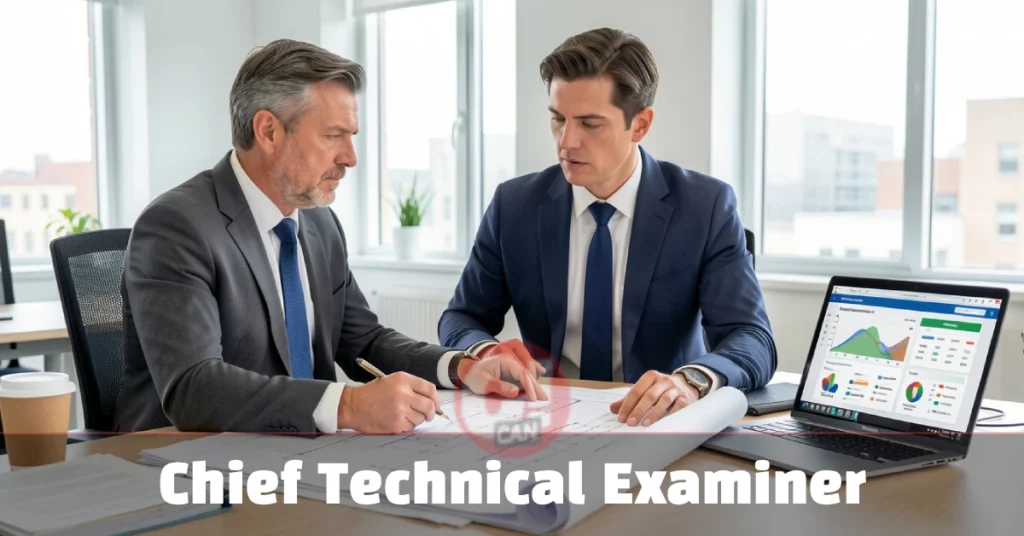
The primary duty is reviewing technical outputs — blueprints, system architectures, material specifications, construction progress, or software deliverables — and confirming they match approved designs and contractual requirements. This is not a rubber-stamp exercise. A CTE examines documentation, visits sites or systems in person when necessary, and cross-references findings against original specifications.
In construction, this might mean verifying that the grade of steel used in a bridge matches the procurement order. In an IT context, it could mean confirming that a deployed system architecture matches what was approved in the design phase.
Compliance and Standards Enforcement
Every industry has a set of rules — some legal, some contractual, some internal to the organization. A Chief Technical Examiner is responsible for making sure technical work stays within those boundaries. When it does not, the CTE documents the gap and escalates accordingly.
This matters because non-compliance is rarely just a paperwork problem. A missed safety standard in a public infrastructure project can result in physical harm. A procurement violation can expose an organization to legal liability. The CTE’s job is to catch these problems before they compound.
Audit Reporting and Risk Documentation
After any inspection, the CTE produces a structured report detailing what was reviewed, what was found, and what — if anything — needs correction. These reports serve multiple audiences: senior management, external auditors, legal teams, and, in government contexts, vigilance or anti-corruption bodies.
Good reporting from a CTE gives an organization a clear picture of its technical risk exposure. It also creates a documented trail that becomes critical if a dispute arises or a project is later investigated.
Chief Technical Examiner in Government Settings
In public sector contexts, particularly in countries with formal vigilance programs, the Chief Technical Examiner holds a role with formal legal authority. Under India’s CVC framework, for example, CTEs have the authority to conduct surprise inspections of ongoing government projects, review tender evaluations, and submit independent technical opinions in disciplinary proceedings.
Why independence matters here: When a government agency awards a contract worth hundreds of millions, the contractor and the project management team both have financial stakes in the outcome. The CTE has none. That structural independence is what makes their findings credible in an investigative or legal context.
Within the Chief Technical Examiners’ Organisation (CTEO) in India, the structure typically involves two Chief Technical Examiners — one focused on civil works, one covering mechanical and electrical procurement — each overseeing a team of technical examiners operating across different regions.
The Role in Private and Corporate Organizations
Outside government, the Chief Technical Examiner’s function shifts slightly in emphasis but not in purpose.
In manufacturing, a CTE may focus on quality assurance — verifying that production processes meet ISO standards or customer specifications before shipment. In the energy sector, the role often centers on safety protocol verification: confirming that equipment installations meet regulatory requirements before commissioning.
In technology companies managing large infrastructure contracts or enterprise software deployments, a CTE-equivalent role involves auditing system implementations against technical design documents, verifying that third-party vendors delivered what was specified, and flagging deviations before the client accepts the deliverable.
Here’s the practical value for a private organization: having someone in this role reduces the cost of errors caught late. A defect identified at the inspection stage costs far less to fix than one discovered after deployment or after a client has already accepted — and paid for — substandard work.
Skills and Qualifications the Role Demands
A Chief Technical Examiner typically holds an engineering degree or equivalent technical qualification in the field they oversee. Beyond the baseline credentials, the role requires a specific combination of skills that not every technically skilled person possesses.
Analytical judgment is central — the ability to review complex technical documentation and identify where something does not add up, even when the paperwork appears correct on the surface.
Communication clarity matters just as much. Findings need to be written and presented in a way that non-technical stakeholders can act on. A report that only engineers can interpret does not serve its purpose.
Ethical independence is the least-discussed but arguably most important quality. A CTE who softens findings to avoid organizational conflict is not performing the role — they are undermining it. This requires a professional posture that prioritizes accuracy over internal politics.
Career paths into this role typically run through technical inspection, quality assurance management, or compliance auditing — often with 10 or more years of domain experience before a professional reaches CTE-level responsibility.
What Organizations Get Wrong About This Role
The most common mistake is treating the Chief Technical Examiner as a formality — a sign-off function that exists to satisfy a regulatory checkbox. Organizations that operate this way tend to give CTEs limited access, compress their review timelines, or assign the title to someone who also manages the projects they are supposed to audit.
That last point is worth emphasizing. A CTE who reports to the same project director whose work they are reviewing has a structural conflict that compromises the entire function. Independence is not an optional feature of the role. It is what makes the role functional.
Organizations that take the CTE function seriously build it into their governance structure from the start — with clear reporting lines, sufficient access to documentation and sites, and leadership that treats CTE findings as binding rather than advisory.
The Broader Value of Technical Oversight
As projects grow more complex — in scale, in technology, in regulatory exposure — the gap between what organizations say they delivered and what they actually delivered tends to widen. A Chief Technical Examiner exists to close that gap.
Whether the context is a government road contract, a hospital construction project, an enterprise software deployment, or a manufacturing supply chain, the function is the same: verify that technical standards were met, document what was not, and give decision-makers the information they need to respond.
That is not a bureaucratic function. It is a risk management one — and in high-stakes technical environments, it is among the more consequential roles an organization can have.